The power to release
Pilate told Jesus he had the power to crucify him and the power to release him. He condemned an innocent man, freed a guilty one, and washed his hands. He isn't the worst of them. He's a sign of what to watch for.
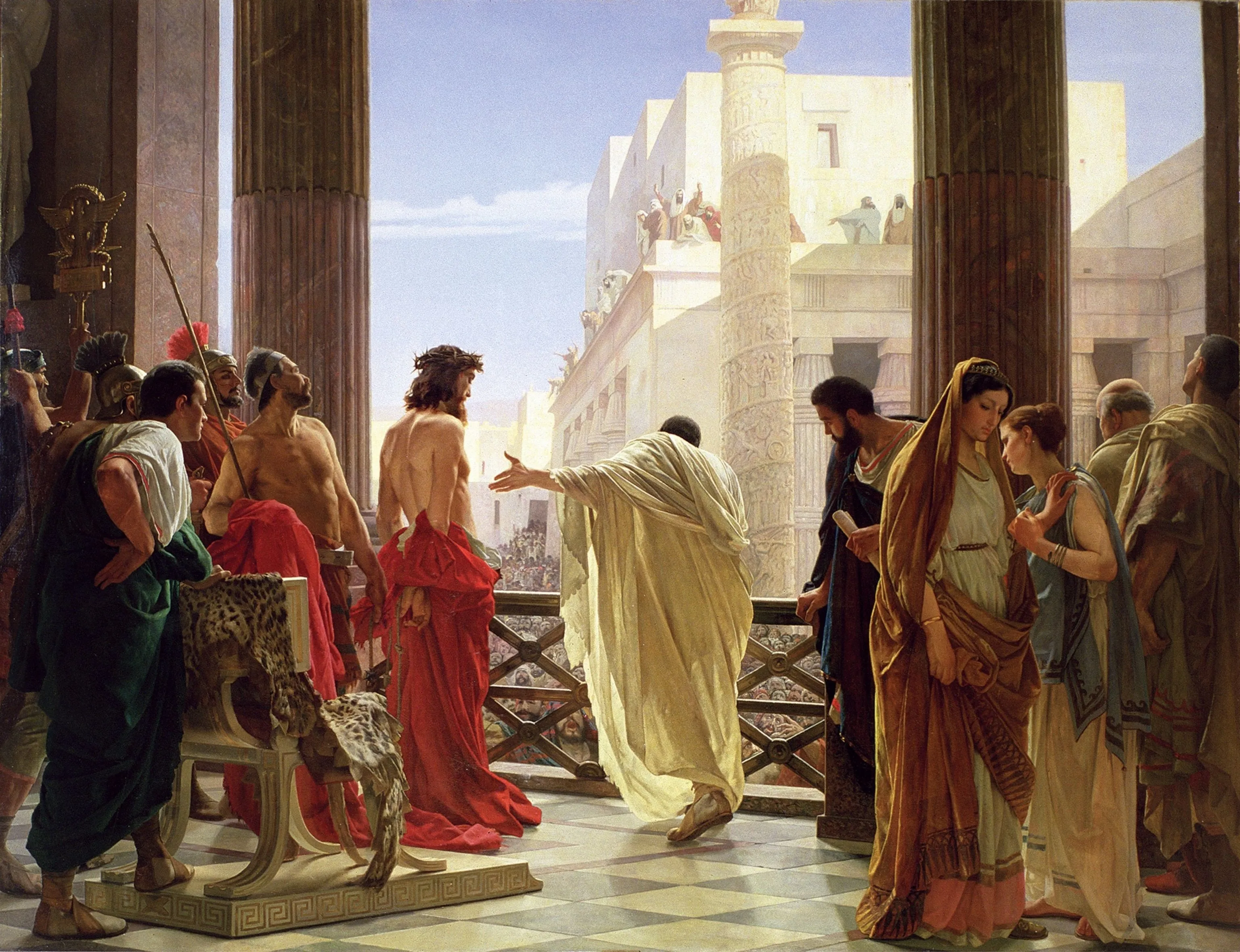
Knowest thou not that I have power to crucify thee, and have power to release thee?
— Pontius Pilate, John 19:10
That’s a man claiming the power of God. To decide who lives and who dies. To look at a person and say guilty, or not guilty, and make it so.
Jesus answered him: “Thou couldest have no power at all against me, except it were given thee from above.”
The power was never Pilate’s. He took it anyway.
What he did with it
He had two men in front of him. One was Jesus, and Pilate said himself that he found no fault in him. The other was Barabbas, held with the rebels “who had committed murder in the insurrection” (Mark 15:7).
He released the murderer and crucified the innocent man.
And he wouldn’t own it. He put the choice to a crowd the chief priests had already stirred up (Mark 15:11). When they threatened his position, “If thou let this man go, thou art not Caesar’s friend” (John 19:12), he gave in. Then he took water and washed his hands in front of them: “I am innocent of the blood of this just person: see ye to it” (Matthew 27:24).
Claim the power. Pretend you can’t control it. Let the crowd carry it. That’s the whole move.
Scripture already had a line for him:
He that justifieth the wicked, and he that condemneth the just, even they both are abomination to the LORD.
— Proverbs 17:15
He did both, in one morning.
Part of the plan, and still guilty
The easy defense is that God meant it to happen. Jesus had to die for our sins. Pilate was only playing his part.
The early church didn’t let him off. Acts 4:27–28 says Herod and Pontius Pilate gathered against Jesus to do what God had already determined, and it names them anyway. It’s what Joseph told the brothers who sold him: “ye thought evil against me; but God meant it unto good” (Genesis 50:20). God can use an evil act. That doesn’t make it a good one.
We don’t accept him as innocent. Christians still say his name in the Creed: suffered under Pontius Pilate.
The real Pilate was worse
The Gospels give us a reluctant Pilate. The people who lived under him didn’t see one.
Philo of Alexandria, writing a few years after Pilate left office, called him “a man of a very inflexible disposition, and very merciless as well as very obstinate,” and listed “his corruption, and his acts of insolence, and his rapine, and his habit of insulting people, and his cruelty, and his continual murders of people untried and uncondemned.”
Josephus says Pilate took money from the Temple treasury to build an aqueduct. When a crowd protested, he planted soldiers among them in plain clothes, carrying clubs, and gave the signal. Many were beaten to death or trampled. Later he sent cavalry against a gathering of Samaritans at Mount Gerizim and executed their leaders, and the governor of Syria finally ordered him back to Rome to answer for it.
He was real. His name is carved in the Pilate Stone, found at Caesarea in 1961: prefect of Judaea.
He isn’t the worst of them. That’s the point. He’s a sign.
The pattern
Pilate served an empire that ruled by the cross. When the Spartacus revolt ended, Rome crucified 6,000 men along the road from Capua to Rome. The power Pilate claimed has passed from hand to hand ever since, and the scale keeps growing. So does the other half of it: the power to look at a criminal and say, not guilty.
Even forgiveness got sold. Luther’s Ninety-five Theses in 1517 went after preachers who said that as soon as the coin rang in the chest, a soul flew out of purgatory. Men selling what only God can give.
Columbus. As governor of Hispaniola he was arrested in 1500 by Francisco de Bobadilla and shipped back to Spain in chains. The testimony gathered against him turned up in the archive at Simancas, and the historian Consuelo Varela published it in 2006. Witnesses describe executions and mutilations, and a boy caught stealing wheat who had his ears and nose cut off. The crown ordered him released, and two years later it paid for another voyage.
Hitler. In 1924 he was tried for high treason for the Beer Hall Putsch. Judge Georg Neithardt gave him the minimum, five years, and declined to deport him, though he was Austrian and the law called for it, because he thought of himself as German and had served in the war. He walked out of Landsberg on probation on December 20, 1924. Then he took the power for himself and condemned millions.
Unit 731. Shirō Ishii’s unit vivisected prisoners and tested biological weapons on Chinese villages. Its experiments killed thousands, and some estimates of the deaths from Japan’s biological warfare run as high as 300,000. The American occupation granted Ishii and his men immunity in exchange for their research. None of them stood trial in Tokyo.
Nuremberg. On January 31, 1951, the American high commissioner in Germany, John McCloy, granted clemency to 78 of the 89 men still held from the Nuremberg trials, including 10 of the 15 sentenced to death. Alfried Krupp, convicted for his company’s use of slave labor, walked out of Landsberg on February 3 with his fortune handed back.
My Lai. Lieutenant William Calley was convicted in 1971 of murdering 22 unarmed civilians and sentenced to life. Three days after the verdict, President Nixon had him moved from prison to house arrest. He served about three years, under house arrest at Fort Benning. It was on the list of cover-ups here too.
Every time, someone with the power to say guilty or not guilty says it, and it’s so. Over one man, then a colony, then a continent.
Be watchful
The kings of the Gentiles exercise lordship over them; and they that exercise authority upon them are called benefactors. But ye shall not be so.
— Jesus, Luke 22:25–26
We were given guidelines on how to live better. A leader who takes the power to condemn and the power to release, and then acts like it isn’t his, is abusing all of us.
Pilate is a sign. Watch who they condemn. Watch who they let go.