It's not demographics
Influencers are blaming a demographic for a crime in the news again. The pattern that actually repeats is the system that covers it up, lets it happen, and sometimes causes it, to protect its reputation and its money.
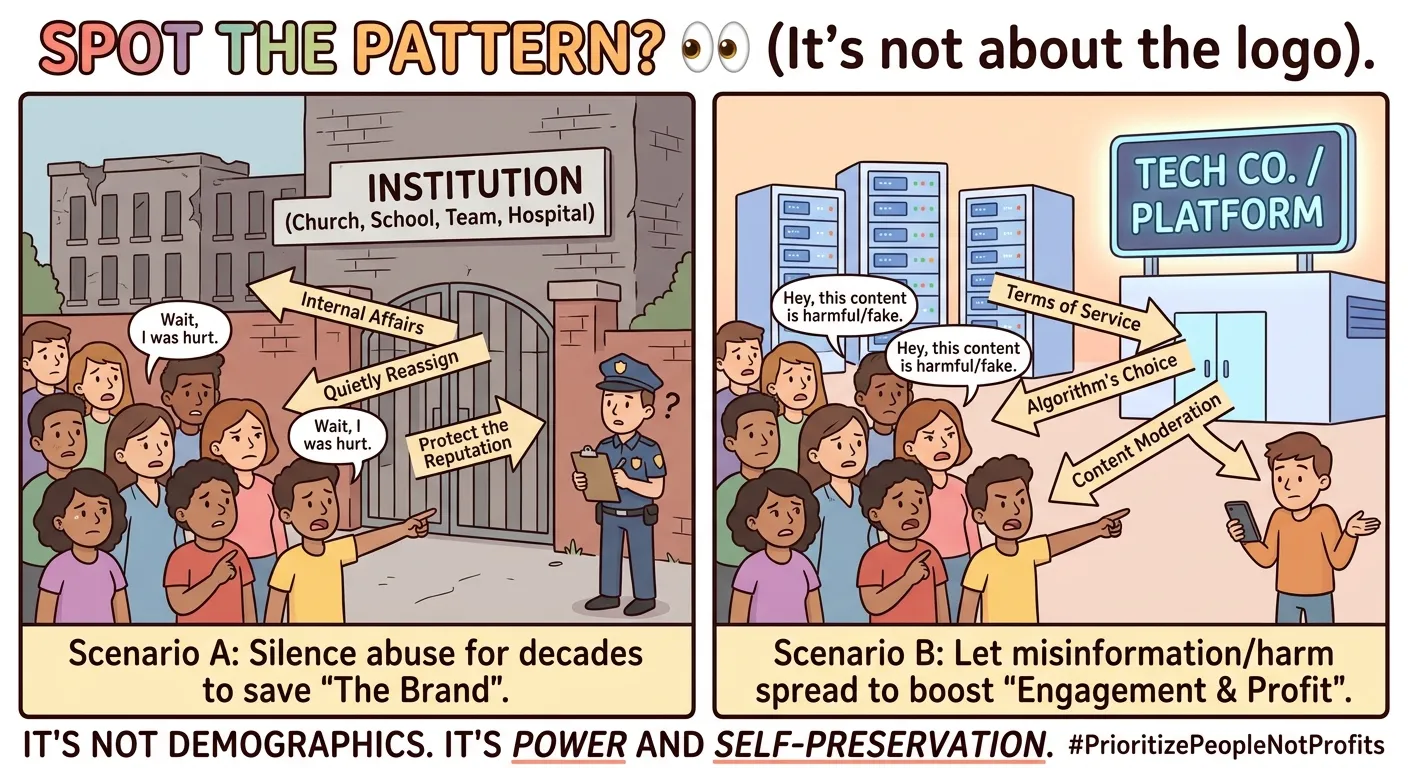
Influencers are blaming a demographic for a crime in the news again. I’m in that demographic, outwardly. They hurl those labels at me. Remember, identity is only yours to define when someone isn’t trying to make a point about how you’re devoid of value. Being told people like me are the cause of it isn’t right. My loved ones, my family and others have been attacked. I was in no position to help, in any way. Why should I carry the shame of detestable criminals? I’m as guilty of their crimes as someone not yet born.
And it isn’t where the pattern is.
The pattern is the system
Demographics don’t run cover-ups. Institutions do. They handle it internally, quietly reassign the problem, and protect the reputation, and they keep doing it for years.
Larry Nassar abused athletes for decades, and he had help. Michigan State had complaints about him going back to the 1990s, cleared him in a 2014 Title IX investigation, and let him go back to seeing patients. The Department of Education later fined the university $4.5 million for failing to respond to reports and failing to protect students. When USA Gymnastics finally took allegations to the FBI in 2015, the Justice Department’s inspector general found that the Indianapolis field office didn’t treat them seriously, broke its own policies, and later gave misleading answers about it. According to the court filings the report cites, about 70 more women and girls were abused in the months that followed.
At Baylor, a 2016 outside investigation found “institutional failures at every level” of the university’s response to sexual assaults by football players. Coaches met with women who reported, and didn’t report it. Staff ran their own internal inquiries that discredited the women. Administrators discouraged students from coming forward at all. The president and the head coach lost their jobs, after years of it.
Different institutions, the same moves. Sometimes the system just lets it happen. Sometimes it’s the reason it happens.
Every one of these had people who did it and a system that let them. Here’s a partial list. It can’t be complete, because the whole point of a cover-up is that you don’t hear about it.
- 1969, US Army: My Lai, a massacre of civilians, covered up for more than a year.
- 1989, US Navy: USS Iowa, the Navy blamed the explosion on a sailor who died in it, then had to back down.
- 1991, US Navy: Tailhook, the Navy’s own investigation of mass sexual assaults stalled until the Pentagon took it over.
- 1996, US Army: Aberdeen, drill sergeants abusing trainees.
- 2002, Catholic Church: Archdiocese of Boston, abusive priests moved from parish to parish.
- 2003, US Air Force: Air Force Academy, cadets who reported assaults were the ones disciplined.
- 2004, US Army: Pat Tillman, a friendly-fire death hidden from his family and the public.
- 2009, Ireland: the Ryan Report, decades of abuse in church-run, state-funded institutions.
- 2011, Penn State: Jerry Sandusky, top officials kept it quiet.
- 2012, Boy Scouts of America: the “perversion files”, decades of files on accused leaders, kept internal.
- 2012, BBC: Jimmy Savile, a star protected for decades, and an investigation shelved.
- 2014, General Motors: ignition switches, a deadly defect known for more than a decade before the recall.
- 2014, State of Michigan: Flint, residents’ complaints about their water dismissed.
- 2015, Volkswagen: Dieselgate, software built to cheat emissions tests.
- 2016, Fox News: Roger Ailes, harassment handled with settlements.
- 2016, Baylor University: football, reports buried by coaches and administrators.
- 2016, USA Gymnastics, Michigan State, the FBI: Larry Nassar, complaints ignored for two decades.
- 2017, The Weinstein Company: Harvey Weinstein, settlements and nondisclosure agreements.
- 2017, Australia: Royal Commission, churches, schools, sports clubs and state care, all failing the same way.
- 2018, Catholic Church: Pennsylvania grand jury, about 300 priests, more than 1,000 children, and senior officials who hid it.
- 2018, University of Southern California: George Tyndall, decades of complaints, then a quiet resignation with a payout.
- 2019, Ohio State University: Richard Strauss, staff knew as early as 1979.
- 2019, Boeing: 737 MAX, regulators misled about the system behind two crashes.
- 2019, Purdue Pharma: OxyContin, the risk of addiction played down.
- 2020, US Army: Fort Hood, an independent review found a command climate that tolerated harassment.
- 2021, University of Michigan: Robert Anderson, staff knew for decades.
- 2021, Chicago Blackhawks: Kyle Beach, team leadership heard about it in 2010 and did nothing.
- 2021, Facebook: the Facebook Files.
- 2022, US Soccer and the NWSL: NWSL, abuse across the league while the people in charge looked away.
- 2022, Southern Baptist Convention: Southern Baptists, leaders kept a private list of accused ministers.
- 2023, Columbia University: Robert Hadden, a doctor allowed back to see patients after he was arrested.
So here’s the question I keep coming back to, and will keep coming back to here: why do humans protect institutions more than each other?
Reputation is money
Protecting the brand and protecting the profits are the same thing. A church with no reputation gets no donations. A university with a scandal loses donors and recruits. A football program loses games and money. A sports federation loses sponsors. The cover-up isn’t about who the abuser was. It’s about what the truth would cost.
We protect companies too
It isn’t only churches, teams and schools. People defend companies the same way, even when the company is the one taking their money. I got banned from Nextdoor because I said it’s not good to defend the bank for overcharging you for checks. I was being uncivil by saying the bank was wrong.
Banks are a fine place to start. Wells Fargo opened millions of accounts its customers never asked for, and employees who called the ethics line about it say they were fired. A federal judge ordered it to pay back $203 million after it reordered customers’ transactions, biggest first, to rack up more overdraft fees.
It doesn’t stop at banks. DuPont knew for decades that a chemical from its Teflon plant was harmful and getting into people’s water. A Reuters investigation found Johnson & Johnson knew for decades that its baby powder sometimes tested positive for asbestos. Exxon’s own scientists predicted climate change while the company spent years casting doubt on it.
Facebook does it to kids. Its own researchers found it was hurting kids: a 2019 internal slide said “We make body image issues worse for one in three teen girls.” In public, its executives played it down.
It’s the same shape every time. You report the harm, and you get routed to the terms of service, the algorithm, and content moderation. The company protects itself, and the people inside it keep their jobs.
I have to find it hilarious: one demographic decrying another, while working in absolutely indefensible industries like the ones I’m mentioning here. They reasoned their way into forgoing their morals to work for bad institutions, but blame innocent people for other people’s crimes.
The Sacklers
The news right now is about sexual assault. One family did more damage than that, to two generations or more, and kept the money.
Everyone I hung out with from 16 to 20 died from these pills. The effects are still being felt. The CDC counts about 806,000 opioid overdose deaths from 1999 to 2023, starting with a wave driven by prescription opioids in the 1990s.
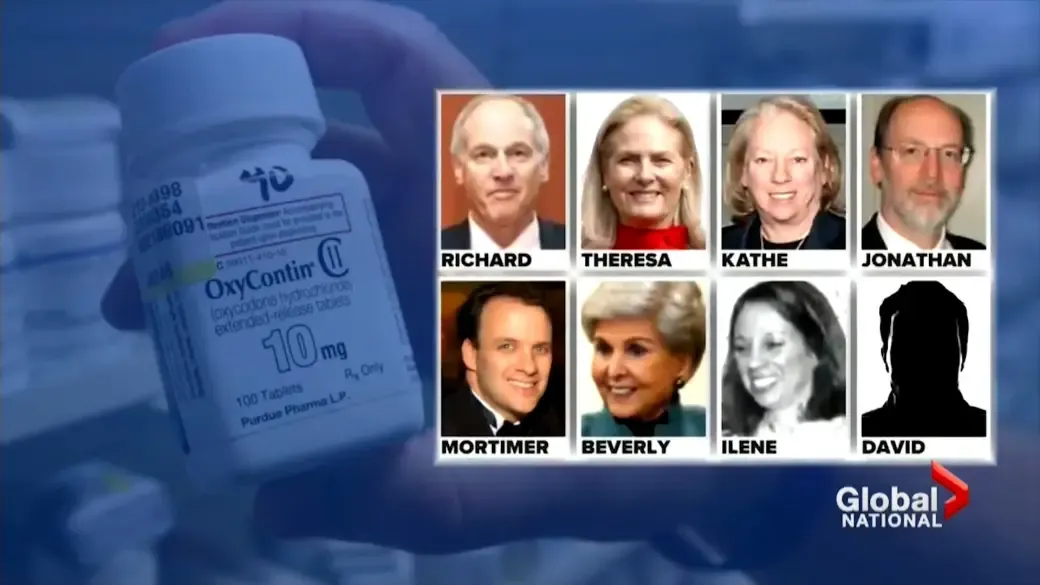
Courtesy of Global News.
Three brothers, Arthur, Mortimer and Raymond Sackler, bought a small drug company called Purdue Frederick in 1952 and built the empire. Arthur died in 1987. Purdue launched OxyContin in 1996, and the families of the other two brothers owned it the whole time it sold it. In 2007 the company pleaded guilty to misleading the public about the risk of addiction, paid $600 million, and kept selling. Eight Sacklers sat on its board. Half of them are women.
They all sold it, and they all benefited. An audit found the family took about $10.4 billion out of Purdue starting in 2008, sometimes into offshore trusts and holding companies. New York’s attorney general said they used Swiss bank accounts to hide transfers.
In 2020 Purdue pleaded guilty again, this time to three federal felonies. The family paid $225 million in a civil settlement, admitted no wrongdoing, and has never been charged with a crime. This year Purdue was dissolved under a $7.4 billion settlement, with the Sacklers paying their share in installments over fifteen years. None of them is in jail.
Blame the people who did it, and the systems that let them
The person who committed the crime is responsible. So is the institution that looked away, covered it up, or made it possible. A demographic isn’t.
Blaming a demographic is bigotry, flat out. Don’t be a bigot. It’s also easy, and it lets the system off the hook.
We’re told only one demographic, or a few, are harmful. Or that people can’t come up with evil on their own, that someone else must have put it in their heads. As if humans are suddenly devoid of agency. The Sacklers had agency, the men and the women. So did the people around Larry Nassar. Kathie Klages, the Michigan State gymnastics coach, was convicted of lying to police about whether gymnasts told her about him in 1997. The conviction was later overturned. The court never said she told the truth. She wasn’t the only one who lied.
A culture of silence runs on greed, narcissism, and protecting the institution that benefits you.
I worked in health insurance, an industry whose goal is blocking people from care. The entire leadership structure was women. On October 24th, one of them told me, “I just do the analytics.” When an institution pays you, you keep doing the harm, every day, over and over. You’re an active participant. People who work in these industries decry the attacks on them. The gall of their moral compass. They feed their kids on denying the needy health care.
Deutsche Bank kept Jeffrey Epstein as a client for years after his conviction. New York’s regulator fined it $150 million for it, and it paid his accusers $75 million more. I know a woman who fed and clothed her kids on that money, while her family worked there. They kept at it to feed their daughters.
LinkedIn is another one. It’s a vile company that says you’re the reason it exists, to help you network and find jobs. I can’t post there because I wasn’t kind to a man without empathy. Now I can’t even repost popular voices on fixing health care in America.
Human greed knows no bounds. Evil has no border, and no demographic.