Social media brain
Somebody disagrees with your post, so they have to be insulted and put down. We side with influencers and strangers over the people we love, and it's costing real relationships.
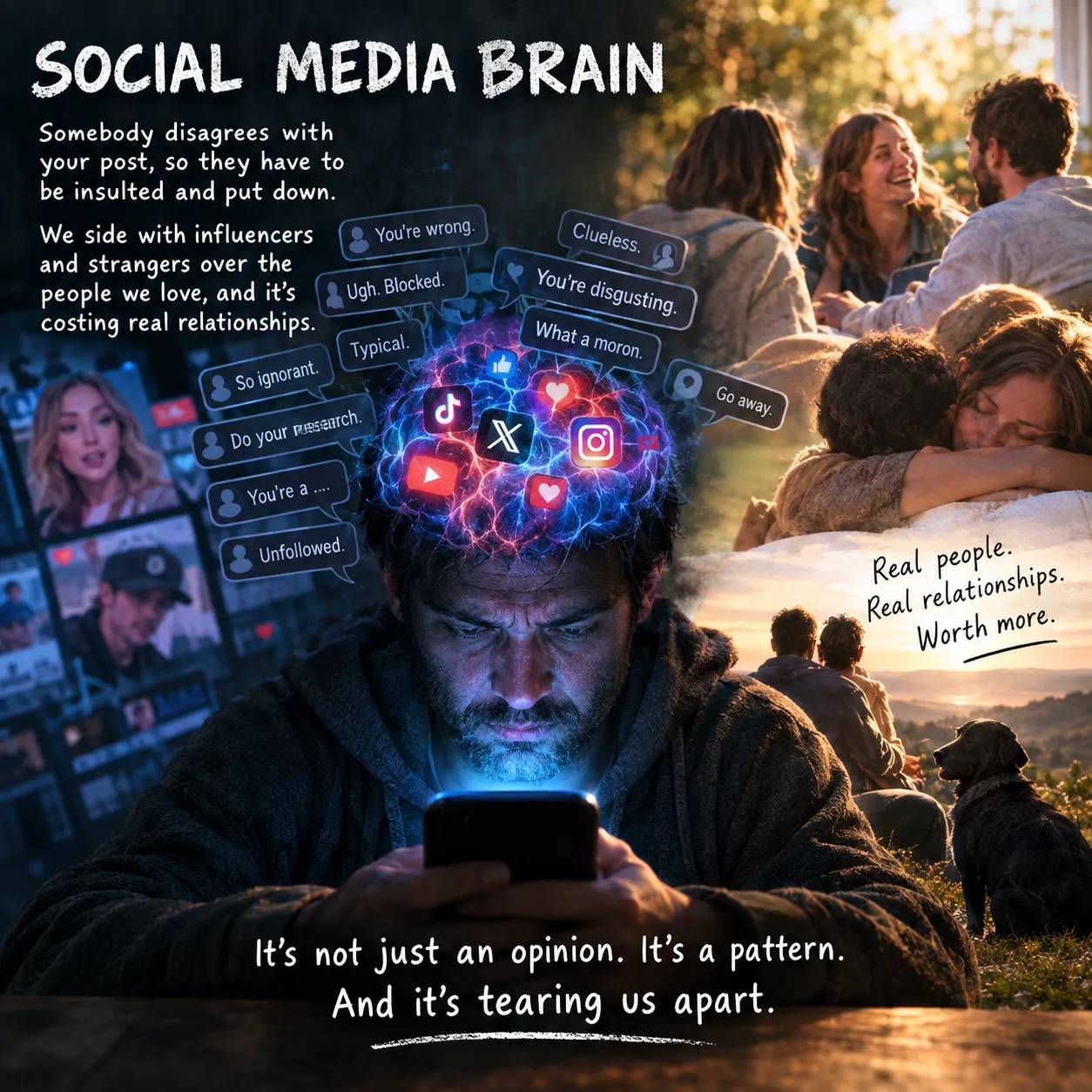
Social media brain goes like this. I made a post. I have an opinion. Anybody who comments on that opinion, I have to dominate, control and insult. There’s never any discussion or debate.
And it costs people actual relationships.
A friend, not a stranger
I engaged with somebody on a personal level about a post they made. I really thought that because we were friends and respected each other, we could have an honest conversation. They dug in deep instead. They’d taken in the influencers and all the other opinions that come through social media, they were sure they were right and justified, and there was all this confirmation bias. You can’t talk anyone out of that. It’s a nightmare.
Institutions over people, again
In the last post I asked why humans protect institutions more than each other. This is the same thing, smaller and closer to home. Social media brain chooses the opinions of institutions, influencers and social media at large, and lets them get between us and the people we love and care about.
I know my friends are different from the people on the feed. I know who they are. But social media brain says they must be insulted, put off, demeaned.
That is kind of what society has become.
Bearing false witness
Here’s how it happens. We don’t like someone’s reply, so we invent reasons they made it. Usually it’s their politics. “You must be a …” Fill in the blank. It happens on both sides, always. That person’s this, this person’s that. And we judge them for it, because they disagreed with us in a small way.
It’s wrong. It’s guessing.
The biggest thing I see is bearing false witness: telling me, and telling everyone else reading, why someone did something, when you can’t possibly know.
Thou shalt not bear false witness against thy neighbour.
— Exodus 20:16
It isn’t just a feeling
There’s research on every piece of this.
The feed pays for contempt. Researchers who looked at about 2.7 million Facebook and Twitter posts from news outlets and members of Congress found that each word about the political other side raised the odds of a post being shared by 67%. Posts dunking on the out-group beat posts with emotional or moral language. An earlier study found that moral and emotional language spreads further, mostly inside a group rather than across it.
It teaches us to do it more. When people’s outraged posts get likes and shares, they post more outrage later. That’s social learning, the same way anything gets trained. Molly Crockett argues that online platforms make expressing outrage cheaper and more rewarding than it ever was in person.
Pushback makes us dig in. In a field experiment, Republicans paid to follow a bot that shared opposing views came out more conservative, not less. Democrats moved slightly more liberal, though that wasn’t statistically significant. Confirmation bias is old and well documented; the feed just gives it an endless supply.
The fantasies are measurably wrong. Democrats and Republicans dislike each other about equally, but each side thinks the other’s prejudice is about twice as strong as it actually is. The more exaggerated that belief, the more people want distance from the other side. John Suler called part of this the online disinhibition effect: with no face in front of you, you fill the other person in with your imagination.
It’s ending friendships. In 2016, Pew found that 27% of social media users had blocked or unfriended someone over politics. 64% said arguing with the other side online left them feeling they had even less in common than they’d thought.
And the influencers feel like friends. In 1956, Donald Horton and Richard Wohl named the parasocial relationship: the one-sided intimacy an audience feels with a person on a screen. They were writing about TV hosts. Now it’s someone you’ve never met, in your pocket all day, and it can outrank someone you’ve known for years.
It isn’t just Democrats and Republicans
Politics is where it’s most obvious online. With every new story, we have to guess at the politics of the offender, and the politics of everyone for and against them. Everything goes into politics.
But it crosses into gender, and religion, and everything else.
Men and women need each other. We’re a species, and we can’t exist without each other. For maybe twenty years I’ve watched a deep gender divide open up, and it’s been built on social media. It’s really scary that this is what society is becoming. We don’t hear each other. We don’t care about each other. We other people, even in the basic human relationships the species needs to continue. That’s fundamentally broken.
We just went through a few months of a story about one gender. Everybody who supported that person was on one side and everybody against them was on the other, and it divided by gender, not by the merits or anything else. Now there’s a different story, with a different gender and a different set of perpetrators, and it’s going exactly the opposite way.
The stories don’t matter here. The point is that we just align with our tribe. And it’s gross that a tribe can be a gender. That’s your spouse on the other side. Maybe one of your own kids.
It’s just a seesaw of hate. No conversation. Anger, pushing, stupidity. Not silence, not listening.
Love
The thing that matters most to me, the thing that compels me most in this world, is love. All of this makes people fight, when all we should be doing is loving each other.
People have told me they didn’t care about me because I differed slightly in an opinion and wanted to have a conversation with them. And I love them.
Do you know what that feels like? To have people tell you they don’t care about you, just because you want to have a conversation with them?